


Abstract
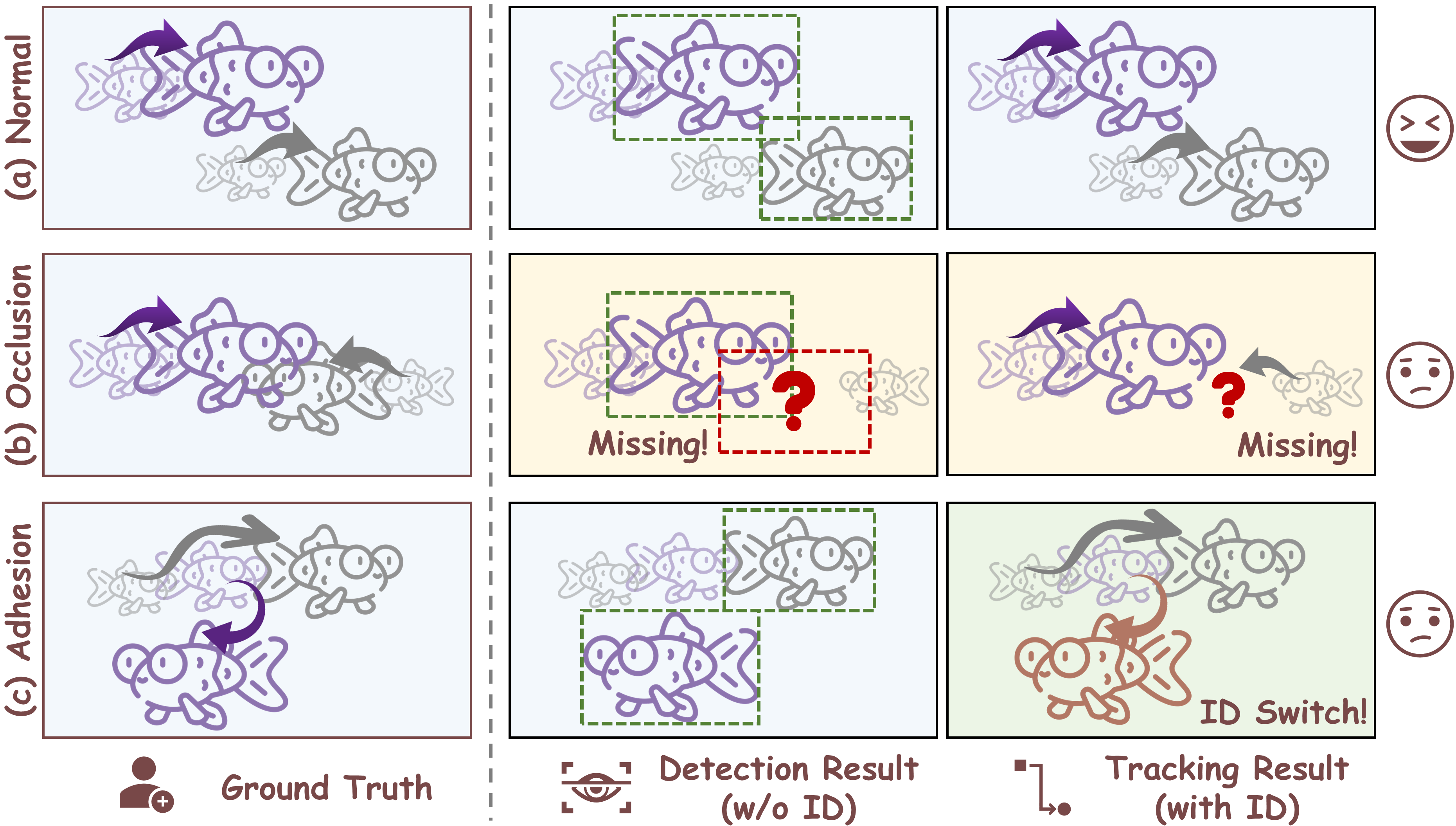
Tracking fish in dense aquaculture environments poses significant challenges due to minimal inter-individual variance, rapid morphological deformations, and frequent occlusions. Recent state-of-the-art methods push accuracy boundaries by employing heavy Separated Detection and Embedding (SDE) paradigms alongside complex association metrics. However, their exorbitant computational overhead prohibits real-time deployment on edge devices.
To bridge the gap between academic benchmarks and resource-constrained industrial deployment, we propose TIDE, a framework for Tracking Identities with Dual-branch Elasticity based on a Joint Detection and Embedding (JDE) paradigm. TIDE offers scalable architectural configurations to flexibly address diverse hardware constraints under a unified design philosophy. Furthermore, we introduce the Adaptive Geometric Correspondence IoU (AGCIoU). This minimalistic association mechanism circumvents the need for computationally expensive re-identification modules and complex morphological metrics. Instead, it leverages robust spatial and geometric cues to effectively maintain identities through severe occlusions with minimal overhead.
Extensive evaluations on challenging stress-test datasets demonstrate that TIDE establishes a superior accuracy-efficiency trade-off. Specifically, the framework achieves highly competitive tracking accuracy with a Higher Order Tracking Accuracy (HOTA) score of 28.43 while operating at a remarkably efficient 20.47G FLOPs. This exceptional efficiency represents a 38.7-fold computational reduction compared to standard heavy-backbone MOT trackers, proving its viability for real-world edge deployment.
Key Contributions
-
Dual-Branch Elastic Framework: We propose TIDE, a computationally elastic JDE framework that effectively resolves the computational bottlenecks of tracking dense, homogeneous targets. It features scalable architectural configurations to flexibly address diverse hardware constraints.
-
Minimalist Geometric Association: We introduce the Adaptive Geometric Correspondence IoU (AGCIoU). As a minimalist alternative to heavy Re-ID networks, it maintains robust identity consistency during severe occlusions using only spatial and geometric cues.
-
Superior Accuracy-Efficiency Balance: We validate TIDE on the specialized MFT-Edge stress-test benchmark. The framework achieves a competitive HOTA of 28.43 at just 20.47G FLOPs. This 38.7-fold computational reduction over standard heavy-backbone trackers proves its viability for industrial edge deployment.
Tracking Performance (MFT-Edge)
Quick Start
1. Prerequisites
- CUDA >= 11.0
- Python >= 3.8
- PyTorch >= 1.7.0
- Ubuntu 18.04 or later (Windows is also supported but may require additional setup)
2. Installation
git clone https://github.com/vranlee/TIDE.git
cd TIDE

conda env create -f requirements.yaml
conda activate TIDE
3. Training Sample
python train.py cmot --exp_id YOUR-EXP-NAMES --data_cfg '../src/lib/cfg/mft_edge.json' --lr 5e-4 --batch_size 16 --wh_weight 0.5 --arch 'tides/tidel' --num_epochs 30 --reid_dim 644. Testing Sample
python track.py cmot --val_MFT_Edge True --data_dir /DATASETS/MFT --load_model ../exp/cmot/YOUR-EXP-NAMES/model_best.pth --arch 'tides/tidel' --conf_thres 0.4Downloads
MFT_Edge Dataset
Dataset for test (utilize MFT25 or your own datasets as well).
BaiduYun (Pwd: wfeq)Pretrained Models
Includes pretrained models and checkpoints for TIDE framework.
BaiduYun (Pwd: v57h)Acknowledgements
A large part of the code is borrowed from sompt22, apple, and ultralytics. Thanks for their wonderful works!
Contact
Any questions or discussion are welcome! If like this work, a star 🌟 would be much appreciated!